

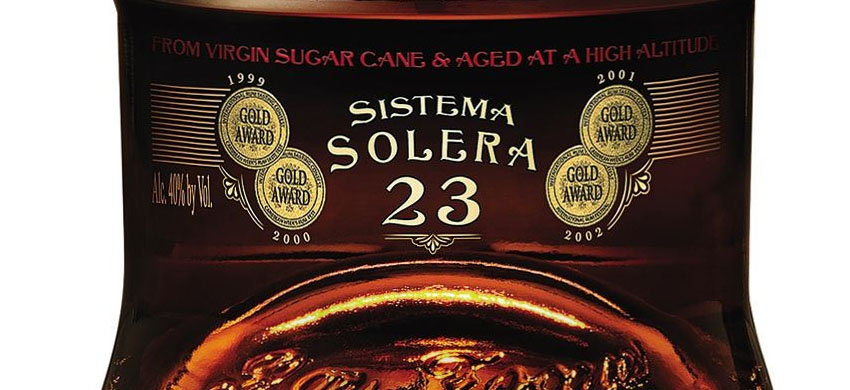
Zacapa's aging and blending facility near Quetzaltenango is where Lorena spends most of her time. Here is where the white oak barrels seek shelter, and where the rum will lie dormant throughout the aging period. This facility is called The House Above the Clouds and it is an important part of the complex ageing system of Zacapa.
This place is situated on the mountainside about 2300 meters (7,655 feet) above sea level. Several atmospheric conditions contribute to this aging process: Here the days are warm and the nights are cool.
Disclaimer: The information contained within this article is as accurate as possible at the time of writing and is only as accurate as the information provided by Zacapa. As such some inaccuracies may be present in the text.
The cold climate of this city is perfect for a slow aging process and according to Lorena; the cooler altitude here helps Zacapa develop its characteristic colour, body, flavour and aroma.
This is in contrast with most Caribbean regions, where the rums age quickly due to their proximity to sea level. It is for this reason that Zacapa ages their rums at a high altitude thus allowing the rum and the wood sufficient time to produce what is technically known as high altitude aging.
The purpose of aging rum is for the wood and the rum to exchange their virtues; the aromas and flavours in the blend, creating a fusion of sensations. The oak and the rum impart their own traits and character which gives birth to a perfectly balanced spirit. During the aging process, the following occurs:
An extraction process during which the rums acquire the aromas and flavours of the wood barrels and also the substances impregnated on them.
An oxidation reaction in which chemical changes take place. The beginning of the aging process is the period when the most oxidation occurs, because there is a higher concentration of dissolved oxygen. In this process there is an increase in the aldehyde and acetic acid content.
Etherification is one of the most important chemical reactions that take place during the aging process. This is when alcohol and acids react. This reaction gives esters to the rum and these esters are the key of the final product. This etherification happens during the ageing, but all basic ingredients start the process during fermentation
Alcohol + Acid <------> Esters and Water.
Time is the perfect companion for the ageing and blending, and it also varies according to the rum being created. The thin air helps the rum to age slower. To age, rum like whiskey needs oxygen. The cool climate with an average temperature of 16.7 degrees Celsius (a bit like Scotland) also helps to slow down the pace of the ageing. The slower the ageing, the finer and more interesting the body, flavour and aroma will become. Lorena said:
“It ages slower here in the mountains than it does on hot islands. Think of simmering food slowly. You extract more flavours than you do with quick cooking. We call it Real Highland Slow Ageing.”
Because of the humidity in this area, the barrels never dry out on the outside (this saves angels share and alcohol).
Zacapa has a complex of warehouses that hold more than 160,000 barrels of rum. In one of them some 10.000 barrels are stacked four to six levels high in the style they use in Spain for the Sherry’s. Lorena explains that to make Zacapa as it is, they use several types of barrels in the ageing process to add as much colour, mellowness, taste and aroma as possible.
Oak
According to the history books, the Celtic people were the first to experiment with bending wood by the use of heat. This gave rise to the production of barrels and the traditional curvature of the staves. This characteristic shape gives these containers their superior resistance and strength. Therefore each barrel, puncheon or cask is a work of art, a perfect balance between the harmony of the object and the simplicity of its shape.
Oak is the common name used for over 250 different species of tree from the Quercus genus. There are two species which are of special interest to the rum industry, Quercus Alba (American White Oak) and Quercus sessiliflora (French Oak).
Most of the species of the Quercus genus have spirally arranged leaves, with a lobed margin. Their wood is hard and compact, with a yellowish tinge. Their impact in the presence of rum, however, is very different.
The barrel is where rum remains for many years throughout the maturation process until it becomes an aged rum. It is assembled by hand by a person known as a cooper.
After being assembled, it undergoes a firing on the inside. This process is done in order to reactivate the wood that will be in contact with the rum in a marriage ritual, where they promise to remain together until they become the perfect couple. The barrels are then sealed with leaves of tul, and aquatic plant found in Lake Atitlan. These leaves will seal each crevice and prevent evaporation or leakage.
The reason for using the tul leaves is because they are inert and don’t impart a smell or flavour to the rum. Since they have always been in constant contact with water, they do not decompose.
Every time an aging cycle is completed, the barrels are inspected prior to being used again. If necessary, they are toasted again or else discarded. For the people at Zacapa, every barrel is a living being which must be nurtured and cared for in optimal conditions so that it may continue to develop.
For the production of rums of Zacapa, different types of barrels are used. Some are made from American White Oak and were previously used to store American Whiskey, Sherry or Pedro Ximenez Wines. Others are made from French oak that stored Cognac.
They each have different degrees of toasting, depending on the final characteristics that are being sought for the different rums. This stage of the production of rums allows Lorena to vary the complexity of the profile that she is seeking in the rum.
Solera System

Most of the rums from other parts of the world use a static aging process. This process consists of filling the barrels with rum, and leaving it in place for an indeterminate period of time.
Frequently, the older barrels don’t contribute much to the aging process anymore, because the wood has been spent. Not here, because the ageing at Zacapa has much similarities with the ageing of Sherry in Spain. It is called the Solera System because the barrels containing the most aged rums are closest to the ground (= suelo) hence the name.
The system is not really the same, so forget what you know about the Sherry Solera System. At Zacapa the name of this system only refers to the blending of several ages in smaller and bigger barrels. Whatever you refer to, the Solera System is a dynamic method:
In the simplest form the Solera System are a set of barrels with liquid of the same type but different ages (Rum, Sherry) stacked on top of each other. The oldest liquid is on the bottom and the youngest is on top. This creates a system for blending.
A fraction of the oldest Rum from the barrel on the bottom is removed and bottled. Then this barrel is filled-up with the next oldest Rum, from the barrels above. This goes on and on until the barrel on top with the youngest rum needs to be filled up with fresh new rum. The barrels are then left to age until the process is repeated.
This system results (by partial removal of the rum from the barrel) in uniformity of the characteristics of the rum. There are a variable number of ‘criaderas’, which are the barrels containing the younger rums. The frequency of the transfers varies according to type of rum that is being prepared. The amount of ‘criaderas’ can vary according to the type of rum being made. When younger and older rums mix, the younger one takes over the characteristics of the older one.
Lorena explains to me that the Solera System that they use is a very good system for ageing rums. She thinks this system gives better result to Zacapa than any other system. This system gives sweetness to the rum, whereas others don’t. This sweetness is derived from the different types of barrels and not from caramel (a product they don’t use by the way). Even if they did use caramel, this type is only used to give colour and not taste to the product!
By using a system like the Solera System (blending different ages into one fine blend) you easily loose track of the ages. The oldest part keeps on getting older while the youngest stays the same. Officially Zacapa should therefore put a different age statement on their bottles each year.
No matter what age the Rum is, with each step that Zacapa takes in the Blending process, there is a man from the government present. He/she makes sure that the people of Zacapa are not adding anything to their rums.
They also make sure that all taxes are correct. The alcohol percentage of the rum changes slowly and each year it will be a little bit less than the year before. The humidity helps to keep this to normal levels.
Zacapa Solera System
The speed of the Solera System depends on the type of rum that is ageing and of the development inside the barrel. Some will stay in a barrel for only 1 year (because it is a new barrel and the ageing happens quicker), others will stay in the barrel for 2 years (because the ageing happens slower or the rum needs more flavours).
In the drawing of the Zacapa Solera System that I made (with the original hand drawing of Lorena as guide) you see several barrels and a part of the alphabet.
They all represent steps in a large system. Each type of Zacapa rum goes through a system like this, but not at the same speed.
The Master Blender already knows from the beginning which spirit will become Zacapa 15, 23 or XO. Zacapa 15 will do all steps a bit quicker than Zacapa 23 or Zacapa XO. Zacapa XO will have an extra step to make it special and different from the others.
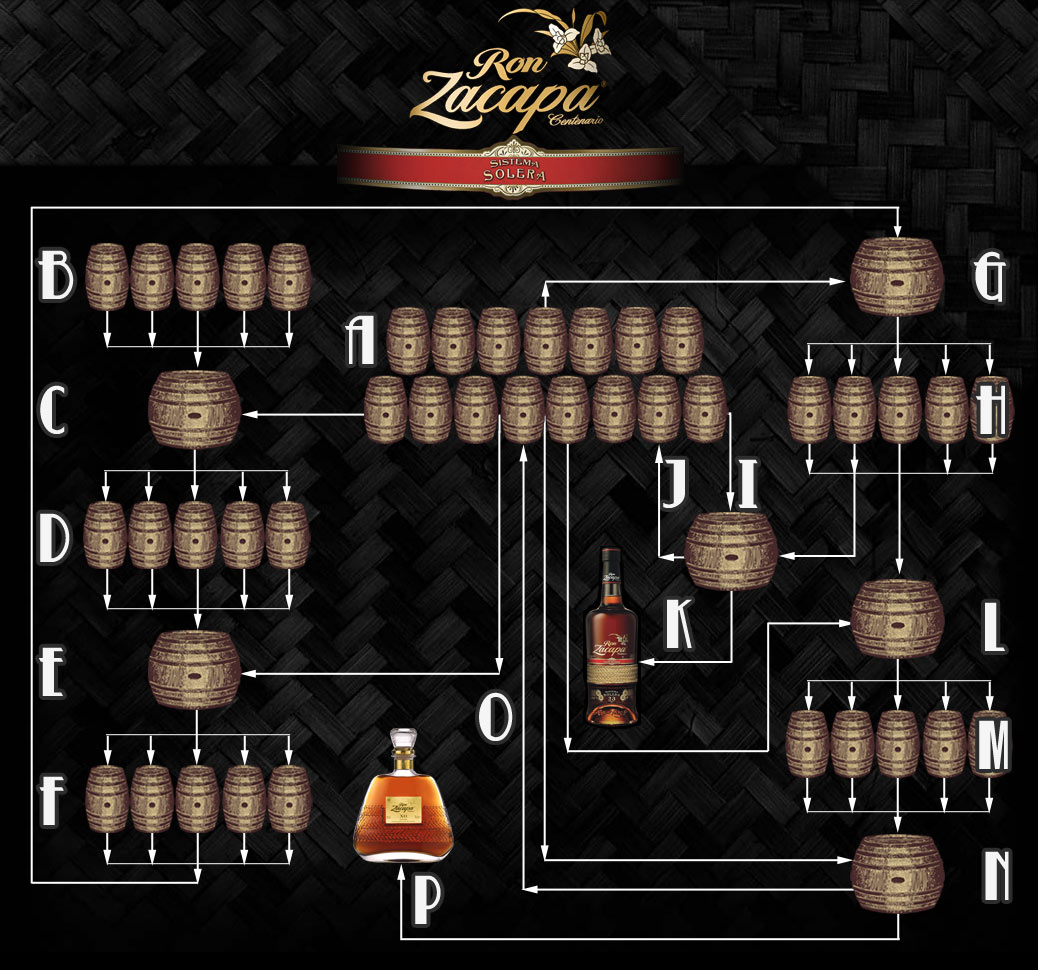
A: This is the basic of the system. Here you see the old Rums in the warehouse. They are al blended together to maintain a continuing quality. Young and old Rums are blended to one product: Old Reserve.
B: This is the fresh spirit of the last harvest. This is put into American Bourbon barrels. When you put a spirit in a used Bourbon barrel you call it “First Fill Bourbon Barrel” (FFBB). It is not the first product in the barrel, because then the name would be New American Oak Barrel. FFBB means this is the first spirit after the Bourbon, so it is the second product in this barrel. This will take between 1½ and 2 years.
C:C, E, G, I, J and L are big wooden barrels/containers that are capable to blend several barrels. These containers have a capacity of 17.000 18.000 litre and are made of American Oak. Here in “C” you will find a blend of all “B” barrels. All barrels are fully emptied. In this big container also some Old Reserve (“A”) is added.
D: During the storage in C, the American Bourbon Barrels (from which this rum originates) are burned again (= re-charring). This is done very heavily and they call the result as “Alligator Skin.” This extra burning is important, since now it is easier for the rum to get into the wood and take out the chocolate and vanilla flavours. It also mellows and sweetens the rum. This heavy burning makes it necessary for the workers to wear fireproof suits.
E: The barrels are emptied in a big container again, and again there is some Old Reserve added. The re-charred barrels are no longer used.
F: The new mixture is put in Sherry Butts. Sherry barrels give a lot of the Zacapa sweetness and fruitiness.
G: The barrels are emptied in a big container again, and yet again some Old Reserve is added.
H: The new mixture is put in Sherry Butts again, but this time it is a PX Sherry Butt. This type of Sherry is very sweet and it is an important component that gives the final Zacapa product lots of its honey sweetness. Pedro Ximenez barrels give notes of raisins and dried fig.
I: Now the rum can go into 2 directions. Zacapa 15 and Zacapa 23 varieties, which will (separately) go into a big container again. After the barrels are emptied into the container again there is some Old Reserve added. Soon after that, they will add water until the alcohol percentage is 46%, ready for consumption. This lowering of the alcohol will take 6 months. No caramel is added and no chill filtering is done. That’s why the alcohol has to stay at 46%; to make sure the rums do not go blind. At 40% this would be the case.
J: The rums that are meant to become Zacapa XO will go into a container as well. They will also be mixed with some extra Old Reserve. But this is not the final station.
K: This pre-XO mixture will be put in Cognac barrels made of French Limousin Oak. This way they get an extra dimension in their flavour. The XO is really different from Zacapa 15 and 23. The French oak is only used for the XO and contributes dry elegance and subtlety.
L: Finally this Rum is mixed in a container to make sure all bottles have the same mixture. No caramel is added and no chill filtering is done.
M: Because there is a lot of Old Reserve Rum used in the mixture, this needs to be replenished. Some of the final mixture goes into the warehouses to be used in some of the next batches of Zacapa. Which one it is, depends on the quality of the new batch.
If we take a closer look to the schedule, the fastest system will take approximately 6 years. This is the rum that will be used for Zacapa 15 and Zacapa 23. The quickest XO tour will be at least 8 years. All these ages are the minimum. Most ages are higher.
Diluting
When the blending stage is finished, the rum is taken to the bottling facilities, where the alcoholic strength is adjusted. All Zacapa rum is aged at an alcoholic strength of 60% alcohol by volume. This aging process is always supervised and controlled by the government of Guatemala. During the ageing the alcohol percentage will go down slowly, so at the end the alcohol percentage is not at 60 anymore.
The rum is filtered and polished and then sent to the automatic bottling line.
During the entire ageing, Lorena and her team do partial tastings. The content of each barrel is analyzed for taste, aroma and colour. They do this on cask strength. They test it cask strength because they taste the Rum straight from the barrel when they walk in the warehouses. Here they make a first selection. Then they take some samples to the lab and dilute these to 20% abv.
Before the rum is bottled it needs to be filtered. This is done with cellulose on room temperature. This makes it necessary to keep the alcohol percentage at 46% or higher. When they lower the alcohol under 46%, the rum can become cloudy in colder places. This doesn’t mean the rum went bad, it just means the rum is cloudy. Nobody will notice a change in the flavour when this happens. During the entire process, critical control points are analyzed by the Quality Control Department which ensures that each one of Zacapa’s rums meets the high standards they have established.
Go back to:
Ron Zacapa Part I: Interview With the Master Blender
Continue to:
Ron Zacapa Part III: The Evolution of the Packaging
René van Hoven (Rumpages.com)
Other articles by René van Hoven:
Mount Gay - The Oldest Rum Brand in the World
Master of all Master Blenders - Don Jose Navarro Part I
Master of all Master Blenders - Don Jose Navarro Part II
Refined Vices Rum Reviews:
Ron Zacapa Centenario 23